Tap-to-explore chart
Grey Glacier, Torres del Paine: blue ice and the icebergs it sheds
Brief answer
Grey Glacier's ice looks blue because dense, bubble-free ice absorbs red light and passes the blue, and its icebergs are pieces calved from the fronts that drift down Lago Grey and strand on the beach.
Why it is blue
Light on the ice
When the sun sets on the glacier, month by month
Choose a month to see the sunset time at Lago Grey and a tip for seeing the blue in that season.
Sunset
Sunset is worked out for the 15th of each month on local time at Lago Grey. Tips draw on USGS and NSIDC glacier science, the boat operator's timetable and Chile Travel.
Editorial team, greyglaciercruise.click · Updated November 12, 2026 · Reading: 8 min
Quick look
- Why blueIce absorbs red light and passes the blue on.1
- Densest is bluestIce with no bubbles left looks the most blue.2
- Slow processFor most glaciers, snow takes more than 100 years to become ice.3
- IcebergsChunks wider than 5 m; smaller pieces are bergy bits and growlers.4
- Where they goFloes drift on a milky lake and can strand in the shallows.5,6
Why glacier ice turns blue
The blue of the Grey Glacier in Torres del Paine has a plain physical cause. According to the US Geological Survey, ice soaks up the longer red wavelengths of daylight and lets the shorter blue ones pass and scatter, and the deeper light travels into ice, the stronger the blue becomes.1 NASA's Earth Observatory uses the same explanation for the striking color of Grey seen from space.7
That is why the color is strongest where the light has to travel through a lot of ice before it reaches your eye: in the walls of a fresh calving scar, inside cracks and in a newly rolled iceberg. A thin sliver held up to the sky looks almost clear, while the same ice seen as a cliff glows. Nothing has been added to the water or the ice. The color is the ice itself, filtering the daylight that falls on it.
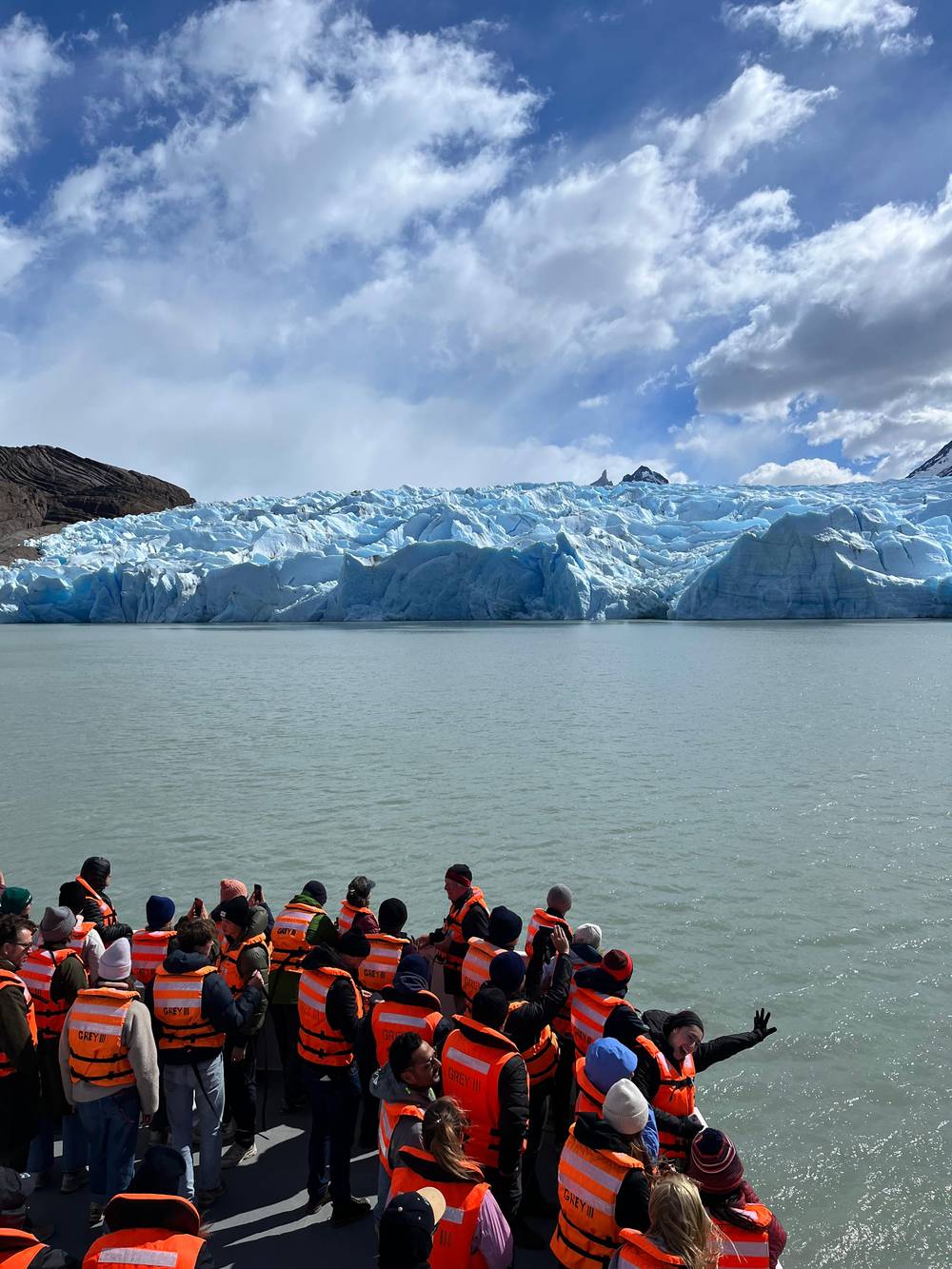
This also explains why the blue changes during the trip. As the boat swings along the fronts, the angle of light into the ice shifts, and faces that looked white from a distance turn blue at close range. Chile Travel, in its suggested park itinerary, presents the catamaran's approach as the moment the textures, cracks and intense blue tones of the ice become clear,8 which is the part of the sailing to spend on deck.
Ice on the lake
Iceberg, bergy bit or growler
| Name | Size | What to look for |
|---|---|---|
| Iceberg | More than 5 m across | Tall blocks near the fronts |
| Bergy bit | Usually under 5 m | Pieces from a breaking iceberg |
| Growler | Under 2 m across | Low ice, under 1 m showing |
| Stranded floe | Any size | Ice grounded in the shallows |
Size classes from NSIDC's glossary; grounding in shallow water as NSIDC describes it.4,17,18,6
From snowfall to blue ice
Blue ice starts as ordinary snow on the ice field. According to NSIDC, the National Snow and Ice Data Center, snow that survives about a year turns into firn, an intermediate stage between snow and glacier ice,10 and its glossary defines firn as snow older than a year with a density above 550 kg per cubic meter.11 Under the weight of new snowfall, the grains keep growing and the air between them keeps shrinking.
The process is slow. For most glaciers it takes more than 100 years for snow to become true glacier ice, and in very old ice individual crystals can grow to the size of an adult fist.3,14 By the time ice reaches the front of a long outlet glacier like Grey, it has been squeezed and carried for a long time, and much of the air that once filled the snow has been pressed out of it.
That compression is what turns white into blue. NSIDC notes that glacier ice often appears blue once it has become very dense and free of bubbles.2 The chain is easy to follow on the boat: soft white snow high on the ice field, firm grey-white surface ice on the tongue, and deep blue in the faces where the oldest, densest ice is exposed. Grey runs for 28 km from the ice field to the lake,15 and the ice at its front has made that whole journey.
White, blue and gray on the same glacier
Not every part of the glacier glows. NSIDC explains that white glacier ice still holds many tiny air bubbles, which bounce light back out before much red has been absorbed.21 The surface of the tongue is often white for that reason, weathered by sun, wind and rain into a crust full of air. The blue sits underneath, which is why fresh breaks and the sides of crevasses show it best.
Gray is real too. NASA notes that the name fits in places, since soil and rock debris collect along the flowing ice in gray-brown ridges called moraines,22 and where side glaciers merge, their debris joins in long dark bands down the middle of the combined glacier.23 From the deck these stripes look like roads drawn across the ice. Some icebergs carry this debris with them, streaked brown and black as they float down the lake.
Cracks add a third texture. Crevasses open where the glacier flows fast and the ice is pulled apart,24 and NASA suggests the complicated crevasse pattern on Grey may come from the glacier splitting into three lobes at its end.25 Where crevasses cross near the front, the ice breaks into pinnacles and blocks, and the walls between them are often the most intense blue on the whole glacier, a natural spot to point the camera.
Plan your shots
How to see the blue at its best
Pick what you most want to capture on Lago Grey.
If I want the bluest ice
Get close to the fronts
Dense, bubble-free ice shows the deepest blue.2
If I want to see ice fall
Stay on the outer deck
Passengers may see and hear pieces break away.19
If I want icebergs on the beach
Walk the shore
Floes drift and can strand in shallow water.6
If I want the whole glacier
Take the boat
The catamaran approaches all three fronts.8
If I want calm, soft light
Take the afternoon boat
The late sailing lands at 18:45, when the sun is lower over the beach.20
The Grey Glacier, Torres del Paine blue ice wall up close
The front is where all of this comes together. The walls stand 30 m tall in Chile Travel's figure,16 and NASA counts three separate lobes where the ice enters the lake.30 The catamaran approaches the fronts so that passengers can study the textures, the cracks and the blue tones up close,8 and that stretch is the reason to come prepared with layers and a charged camera.
Ice at the front is always on the move. NASA explains that Grey loses ice from its end where it meets the water, the process called calving, which produces large chunks of floating ice.13 The boat operator promises nothing, but says that lucky passengers see and hear chunks of the glacier crash into the water.19 The sound often arrives a moment after the sight, a deep crack that rolls across the water.
Plan your time on deck around this part of the trip. Indoors you see the wall through glass; outside you hear it, feel the colder air and catch the colors without reflections. The tour we sell lists 2.75 hours of sailing on the lake, and the closest approach to the ice is a short slice of that time, so be on the outer deck before the boat turns towards the fronts.
See the blue
Price the boat to the ice for your group
Sail to the fronts from the hotel, or book the road in too.
Compare 3 alternatives
Price the boat to the ice for your group
Sail to the fronts from the hotel, or book the road in too.
- Boat from the hotelGrey III sailing · per person, from $120
≈
View - Boat with transferFrom Puerto Natales · per person, from $276
≈
View - Boat and park daySmall group · per person, from $290
≈
View
GetYourGuide's starting prices, converted at the ECB reference rate; exact pricing appears when you book.
Life of the ice
From snowflake to stranded iceberg
On the ice field
Fresh snow
Snow piles up on the Southern Patagonian Ice Field.9
After about a year
Firn
Surviving snow turns into firn, denser than fresh snow.10,11
Over the long term
Glacier ice
Down the valley
Flowing tongue
The glacier deforms and slides towards the lake.12
At the front
Calving
Blocks break off the ice walls into the water.13
On the lake
Drift and stranding
Floes drift and can ground on the shore.6
How the icebergs are born
Every iceberg on Lago Grey starts as a piece of the glacier front. NSIDC defines calving as ice breaking off a glacier's terminus, a term usually kept for glaciers that end in the sea or in lakes,31 and Grey is that kind of lake-ending glacier. Chile Travel describes the ice reaching the lake and breaking apart into blue floes that float on the water.15
Most calving is small: a slab off a pinnacle, a shower of fragments, a block that tips forward and drops. Occasionally a much larger section goes. Chile Travel recalls a large break in 2017, after which the glacier went on drawing visitors as before.32 Breaks on that scale fill the lake with ice for a while, and the fronts have been pulling back for decades: NASA's comparison of 1986 and 2007 images showed all three lobes retreating.33
What a newly calved piece looks like depends on where it came from. Ice from deep in the wall comes out dense and blue; ice from near the surface is whiter and full of air. Debris-laden ice from the margins floats as dirty gray blocks. Over the following days the sun and the water round off the sharp edges, so a freshly broken block and an old drifting iceberg look very different on the same afternoon.
Video
Why glaciers are blue
The Science Writer on YouTube · Nothing is fetched until you hit play.
Glacier ice is blue because the red (long wavelengths) part of white light is absorbed by ice and the blue (short wavelengths) light is transmitted and scattered.
Camera bag
Blue ice photo checklist
Grey Glacier icebergs, from giants to growlers
Grey Glacier icebergs in Torres del Paine come in every size, and glaciologists name them by it. NSIDC applies the word iceberg to chunks of ice more than 5 m across and calls smaller pieces bergy bits and growlers.4 Bergy bits are usually under 5 m and often come from icebergs breaking up,17 while a growler is under 2 m across and shows less than 1 m above the water.18
On the lake you will see all of these together. In Chile Travel's park itinerary the catamaran weaves between icebergs of surprising shapes and sizes on the way to the glacier,34 and the smaller fragments bob low in the water around them. Near the fronts the ice is fresh and angular; farther down the lake the pieces you pass are older, smaller and smoother.
Every iceberg is melting from all sides. NSIDC explains that warmer water melts icebergs from the bottom up while the air works on their tops,35 so the underwater part shrinks and the iceberg can suddenly roll to a new position. That is when the bluest faces appear, freshly turned towards the sky. It is also why the shape of the floating ice changes from day to day, and why every sailing shows a different lake.
Where the ice ends up, and how to photograph it
Icebergs do not stay where they calve. NSIDC notes that icebergs drift and sometimes run into the shore or get caught in shallow water,6 and on Lago Grey that is how pieces end up stranded along the beach. Chile Travel describes the lake as milky water dotted with blue ice floes,5 and boat passengers walk along a black sand beach before boarding,36 often passing ice lying in the shallows.
Enjoy the stranded ice from the shore. CONAF bans swimming anywhere in the park's waters, citing the danger of drowning,27 and floating or grounded ice can roll without warning as it melts. Keep children close, stay on the marked paths, and photograph the ice against the black sand rather than climbing on it. The contrast of blue ice, dark beach and gray water makes the shore worth time before or after the sailing.
Light changes the blue all day. Under an overcast sky the glare drops and the color often looks deeper; in bright sun the surfaces glare white and the blue retreats into the shadows. A polarizing filter helps with reflections off the water. Look up when the sun sets in your travel month before you book, and if you take the afternoon boat, the walk back along the beach is the time for low-angle shots of the stranded ice.
FAQ
Short questions, short answers.
Why is the Grey Glacier blue?
Daylight loses its red end inside the ice, and the blue that remains is what reaches your eye; thicker ice means a stronger blue.1
Why is some of the ice white?
White glacier ice contains many tiny bubbles that reflect light before much red is absorbed.21
How old is the blue ice?
For most glaciers, turning snow into glacier ice takes more than 100 years.3
What is calving?
It is the breaking of ice from a glacier's end, usually at glaciers ending in the sea or lakes.31
How big is an iceberg?
Can I touch the icebergs on the beach?
Swimming is banned in the park's lakes, and melting ice can roll; enjoy it from the shore.27
Sources
- U.S. Geological Survey (USGS) · Why is glacier ice blue? ↩
- National Snow and Ice Data Center (NSIDC, University of Colorado Boulder) · Glacier quick facts ↩
- National Snow and Ice Data Center (NSIDC, University of Colorado Boulder) · Glacier quick facts ↩
- National Snow and Ice Data Center (NSIDC, University of Colorado Boulder) · Glacier quick facts ↩
- Chile Travel (Sernatur, Chile National Tourism Service) · Essential Torres del Paine: Base Torres and Grey Glacier ↩
- National Snow and Ice Data Center (NSIDC, University of Colorado Boulder) · Glacier quick facts ↩
- NASA Earth Observatory · Grey Glacier, Chile ↩
- Chile Travel (Sernatur, Chile National Tourism Service) · Essential Torres del Paine: Base Torres and Grey Glacier ↩
- CONAF, Corporacion Nacional Forestal (Chile) · Parque Nacional Torres del Paine ↩
- National Snow and Ice Data Center (NSIDC, University of Colorado Boulder) · Glacier quick facts ↩
- National Snow and Ice Data Center (NSIDC, University of Colorado Boulder) · Cryosphere glossary: firn ↩
- National Snow and Ice Data Center (NSIDC, University of Colorado Boulder) · Science of glaciers ↩
- NASA Earth Observatory · Grey Glacier, Chile ↩
- National Snow and Ice Data Center (NSIDC, University of Colorado Boulder) · Glacier quick facts ↩
- Chile Travel (Sernatur, Chile National Tourism Service) · Grey Glacier ↩
- Chile Travel (Sernatur, Chile National Tourism Service) · Grey Glacier ↩
- National Snow and Ice Data Center (NSIDC, University of Colorado Boulder) · Cryosphere glossary: bergy bit ↩
- National Snow and Ice Data Center (NSIDC, University of Colorado Boulder) · Cryosphere glossary: growler ↩
- Hotel Lago Grey (operator of the Grey III boat) · Navigation ↩
- Hotel Lago Grey (operator of the Grey III boat) · Navegacion ↩
- National Snow and Ice Data Center (NSIDC, University of Colorado Boulder) · Glacier quick facts ↩
- NASA Earth Observatory · Grey Glacier, Chile ↩
- NASA Earth Observatory · Grey Glacier, Chile ↩
- National Snow and Ice Data Center (NSIDC, University of Colorado Boulder) · Science of glaciers ↩
- NASA Earth Observatory · Grey Glacier, Chile ↩
- Chile Travel (Sernatur, Chile National Tourism Service) · Torres del Paine: How to get there and where to stay ↩
- CONAF, Parque Nacional Torres del Paine · Trekking map and rules 2023-24 (English leaflet, PDF) ↩
- Hotel Lago Grey (operator of the Grey III boat) · Navegacion ↩
- CONAF, Corporacion Nacional Forestal (Chile) · Parque Nacional Torres del Paine ↩
- NASA Earth Observatory · Grey Glacier, Chile ↩
- National Snow and Ice Data Center (NSIDC, University of Colorado Boulder) · Cryosphere glossary: calving ↩
- Chile Travel (Sernatur, Chile National Tourism Service) · Visit the most impressive glaciers of the Chilean Patagonia ↩
- NASA Earth Observatory · Grey Glacier, Chile ↩
- Chile Travel (Sernatur, Chile National Tourism Service) · Essential Torres del Paine: Base Torres and Grey Glacier ↩
- National Snow and Ice Data Center (NSIDC, University of Colorado Boulder) · Glacier quick facts ↩
- Chile Travel (Sernatur, Chile National Tourism Service) · Essential Torres del Paine: Base Torres and Grey Glacier ↩
More to read